A First Visit to a Small Exhibition: A Way to Look Slowly
A first visit to a small exhibition can feel unhurried: use a simple sequence to notice a few works, follow a visual question and form your own response.
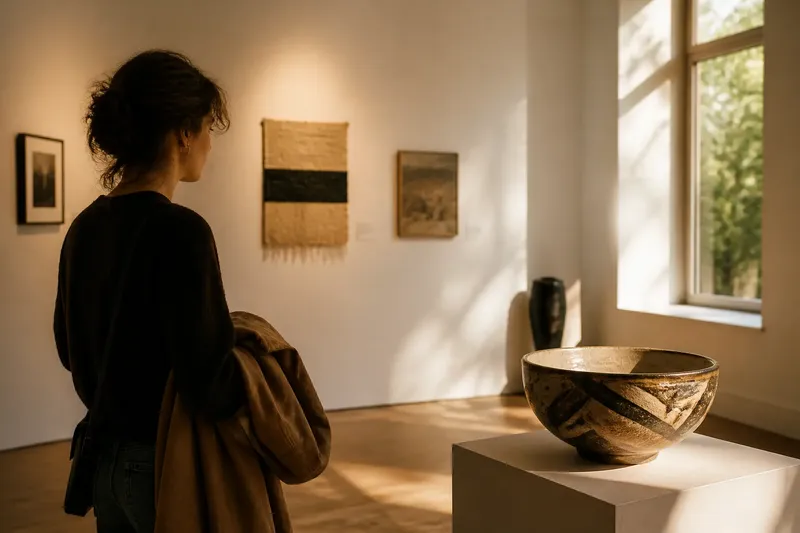
You pause just inside a small gallery, still holding your coat, while a painted bowl catches the light from the window. A first visit to a small exhibition need not begin with a plan to understand everything. Give yourself room to arrive, choose a few works and notice what holds your attention.
Begin by settling into the room
Before moving towards the nearest work, let your eyes adjust to the room. Notice its shape, the direction of the light, the spaces between objects and the general sound level. A narrow gallery with works hung close together asks for a different pace from a bright room with a single sculpture at its centre.
Take off your coat or put away anything you do not need to carry, if the venue allows. Check the entrance for a room plan, a short exhibition note or a request about photography. These practical details can help you feel at ease, but there is no need to read every piece of information before looking.
Choose a comfortable pace rather than trying to match other visitors. If someone is standing where you hoped to look, move on and return later. A small exhibition is often easy to revisit within the same visit; you do not have to claim a spot or wait for a perfect moment.
Make a first pass without stopping at everything
Walk around the room once at an easy pace. Let your attention settle where it will: perhaps on a bright colour, a repeated shape, a patch of rough material or an unexpected gap between objects. At this stage, the aim is not to make a judgement. You are finding the room’s points of interest.
Notice how the works are arranged. Are they grouped by material, subject or scale? Does one object sit apart from the others? A display can suggest connections, but it does not require you to accept a single interpretation. You might simply register that a cluster of small drawings feels intimate while a larger work seems to dominate the room.
When something draws you in, remember its position rather than trying to memorise its title. You can return to it after the first circuit. This gentle overview also helps you see whether the exhibition has a clear route or whether it invites you to wander.
Choose a few works and stay with one
On your next pass, pick a small number of works to look at more closely. A few is enough. Choose one that appealed to you straight away, one that puzzled or unsettled you, and perhaps one that seems connected to the first. You can choose differently; the point is to give your attention a shape without turning the visit into an assignment.
Stand at a distance that lets you see the whole work, then move closer if the gallery permits. Look first at the overall arrangement: where the eye goes, what feels balanced or uneven, and what seems to be in the foreground or background. Then notice smaller details such as a scraped edge, a fine line, a change in texture or the way a material catches the light.
Give each chosen work a little time before reading its label. This makes it easier to distinguish what you can see from what you have been told. You may discover that the work feels different once you know its medium or context; the first impression still belongs to you, and there is no need to discard it.
Say you notice a small woven panel with a dark stripe running across its centre. You look at the stripe, then at the loose threads along the edge, and wonder whether the contrast is deliberate or a feature of the material. After reading the label, you learn what fibres were used; the observable result is a more specific question about how the maker arranged them, not a requirement to arrive at one correct meaning.
Follow one visual question through the room
Once you have spent time with a work, let one question guide the next part of your visit. Keep it simple and tied to what you can see. You might ask, “Where does the eye travel?”, “What changes from one object to the next?” or “How does this material alter the feeling of the subject?”
Carry that question to another work, then notice whether it still helps. If you are looking at a group of portraits, for instance, you might attend to how each person is turned towards or away from the viewer. In a display of ceramics, you could compare the surfaces: glossy, matte, marked or left visibly uneven. The question need not produce an answer. It can make looking more attentive.
Let the question change when the room gives you a better one. A search for repeated colours might turn into an interest in empty space; an initial focus on subject matter might shift towards the marks made by a brush or tool. The exhibition is not a puzzle to solve. A useful question is one that keeps your attention alive without making you feel obliged to explain every detail.
Use labels and room text as another layer
After looking, read the label for a work that still interests you. A title, material or brief note may clarify something you noticed, or draw attention to an aspect you missed. Read for context that bears on your own observation rather than treating every sentence as an instruction about what to feel.
If the exhibition has a longer introductory text, you can read it now, or leave it until later. It may explain why the works are grouped together, name a theme or provide information about their makers. Then return to one object and see whether the new context changes what you notice. It is equally reasonable for your visual response to remain much the same.
Labels can be useful without being the centre of the visit. You do not need to read every one, and you can skip specialist terms that do not help you look. If a name or material matters to you, note it in a phone or small notebook, provided note-taking is permitted.
Questions that help when your attention wanders?
How long should I spend in a small exhibition?
There is no required length of stay. You might spend a short while with a handful of works and leave when your attention feels complete, or stay longer if the room continues to invite you in.
What if I do not understand the work?
Start with what is visible: material, colour, scale, texture, arrangement or the feeling of looking at it. Understanding can include a careful description of what remains unclear, rather than a final explanation.
Should I read every exhibition label?
No. Read the labels that seem likely to deepen a question or clarify a detail you have noticed. Skipping the rest leaves more time for the works themselves.
Is it acceptable to leave and come back?
Yes, if the venue’s entry arrangements allow it. A short pause or a return to a work you passed earlier can make the visit feel less pressured.
Leave space for your own response
Near the end of the visit, return to the work that has stayed with you most. It need not be the largest, most famous or most immediately pleasing. Notice what you remember about it before checking its label again: perhaps a shape, a mood, a difficult detail or the way it altered your pace in the room.
If you want to keep a trace of the visit, write a few lines or make a simple sketch. Record what you saw and what you wondered, rather than trying to produce a polished review. A note such as “rough blue edge; feels like a shoreline, though no water is shown” preserves both the observation and the uncertainty.
It is not worth the effort to photograph every work or to force a personal meaning out of each one. Follow the gallery’s photography rules, and let some impressions remain unrecorded. Attention is not a task to complete, and an unfinished thought can be a perfectly good response.
As you leave, carry one precise detail with you: the grain of a wooden frame, a line that seemed to stop too soon, or the contrast between two objects. That is enough to make a first visit to a small exhibition feel like your own, and it gives you something concrete to notice the next time you encounter art.