The Museum Label Is Not the Object
Museum labels guide attention and offer useful context, but learn how to read their concise accounts without mistaking them for an object’s full history.
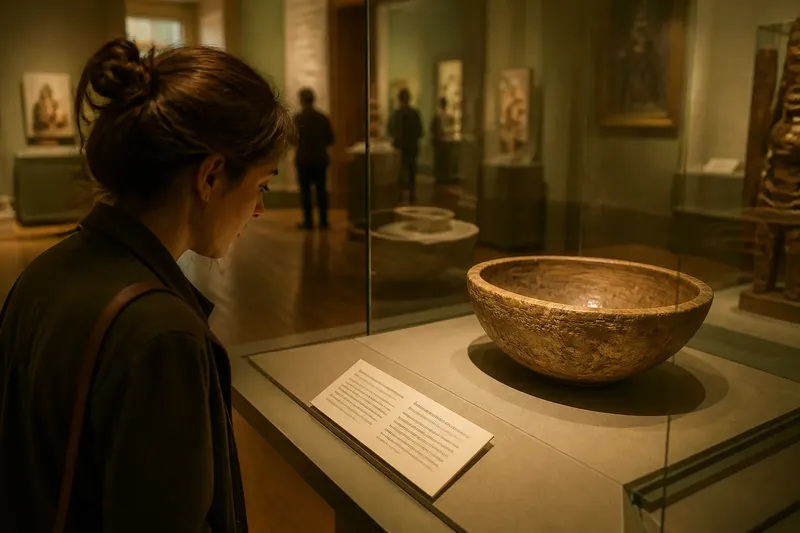
A museum label can redirect your gaze before you have settled on what you see. Beside a carved bowl, a line about its use may make a worn rim seem purposeful; a note about its maker may draw your eye to a signature. The museum label is a starting point for looking, not a substitute for the object or the histories it cannot contain.
Its brevity is useful. A label can identify, orient and suggest a question while leaving room for the object to resist a neat explanation. These five points help you read that small text with curiosity and care.
1. The label chooses what enters the frame
Space is scarce, so a curator selects details that help a visitor approach the object. A label might foreground material, maker, place, date, function or the circumstances of the museum’s acquisition. That choice establishes a frame: it tells you what the institution considers most helpful to notice first.
Look at what the wording directs you towards. Does it mention a polished surface, an unusual joining technique or a figure carved into the handle? Then look for that feature yourself. The label becomes more useful when it sends your attention back to the object rather than replacing direct observation.
The frame also leaves things outside it. A label about craftsmanship may say little about ownership; one centred on a famous maker may give little space to assistants or later users. This does not automatically make the account misleading. It does mean that a chosen emphasis is not the same as a complete account.
2. Concision is a limit, not a flaw
A label must be readable while people stand, move and share the gallery. It cannot carry the detail of a catalogue, the differing interpretations of specialists and communities, and every change in an object’s life. Its short form necessarily compresses.
Notice how that compression works. A sentence such as “used in domestic settings” may gather varied practices into one broad phrase. “Made in” may refer to a place of production without telling you who commissioned the work, who owned it or where it travelled later. Such phrases can orient you, but they leave questions open.
It is not worth the effort to treat each short label as a puzzle whose hidden answer you must uncover. Instead, mark the boundary between what it says and what it does not claim to say. That modest distinction makes room for both trust and doubt.
3. The object’s life exceeds its first purpose
Objects change through use, exchange, repair, display and preservation. A tool may become a family keepsake; a ceremonial object may be removed from its setting and displayed as art. Even a well-researched label may focus on one part of this history because that is the part most relevant to the exhibition.
Say you are looking at a woven basket with a label that identifies its materials and the community associated with its making. You notice a repaired edge and a handle shaped by repeated use. The label has helped you identify a context; looking closely adds visible evidence of handling and care. You can then ask whether the repair is discussed elsewhere, without assuming that it reveals a particular story on its own.
Distinguish observation from inference. “The rim is repaired” describes what you can see; “it was repaired by its original owner” is a further claim that needs evidence. A museum label may provide that evidence, but its silence does not license a confident guess.
4. A label carries an institutional voice
Labels are written and approved by people working within museums, and their language reflects decisions about naming, attribution and authority. Terms such as “anonymous”, “unknown” or “traditional” may sound neutral, yet each can shape what visitors imagine about makers and communities.
Pay attention to whose knowledge is named. Does the text identify a community, a source of information or a contributor to the account? Does it describe a contested interpretation as settled fact, or show where knowledge remains uncertain? These cues help you understand not only the object but also how the museum presents its own account.
Institutions can revise labels as scholarship, relationships and public understanding change. A later version may add a maker’s name, clarify the route by which an object entered a collection or use language developed with people connected to it. Such revision is not evidence that every earlier statement was useless. It shows that museum interpretation is made, reviewed and situated.
5. Keep the question open after reading
Once you have read the label, return to the object and separate three things: what the text states, what you can directly observe, and what remains unknown to you. This is not a formal exercise to complete at every case. It is a simple way to keep a concise account from becoming the only account in your mind.
If an exhibition offers a catalogue, audio guide or linked collection record, those materials may add detail about provenance, technique or interpretation. They may also answer a different question from the label. Choose the source that suits your curiosity, and remember that more text does not automatically mean a fuller history.
What should you ask after reading a museum label?
Why are museum labels so short?
They are designed to be read in a gallery, where people are moving among objects and competing demands on their attention. Their brevity makes them an introduction, not a full research record.
Can a museum label be wrong?
Labels can contain errors or reflect interpretations that later change. If a claim matters to your understanding, compare it with the exhibition’s wider material or the museum’s collection information, where available.
What does a label leave out?
It may omit parts of an object’s use, ownership, movement, repair or cultural significance, as well as disagreements about its interpretation. The omission may reflect limited space, available evidence or the exhibition’s particular focus.
How can you look beyond the label?
Read it, then notice the object’s visible materials, marks and form without treating them as proof of a story. If a question remains, seek another museum source or ask a gallery staff member whether further information is available.
A museum label earns its place when it makes looking more attentive, not when it appears to close every question. Read it as one carefully chosen voice beside the object, then let the object’s visible details and the limits of the account remain in view. That is the useful promise of a museum label: a way into the history, not the history entire.