The Salon Before the Gallery: Art on Display in Private Rooms
The salon before the gallery made art a social encounter; see how room, host and conversation shaped what visitors noticed and artists could show.
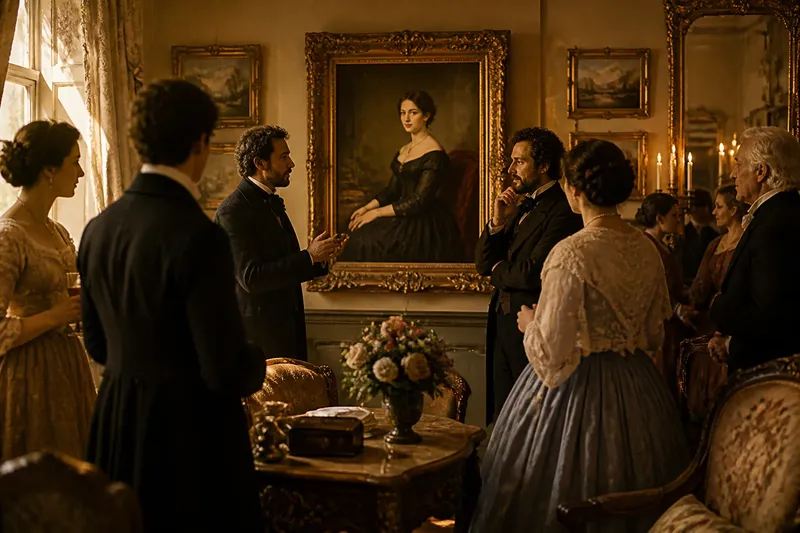
In a crowded drawing room, a visitor might turn from a landscape to greet the host, then return to the picture while someone nearby described its maker. The salon before the gallery was not simply a smaller exhibition space. It joined looking to conversation, hospitality and social access, shaping how art was seen before public galleries became familiar.
To understand that setting, follow the rhythm of an imagined salon evening rather than treating it as a still arrangement of paintings. The room’s changing audience mattered as much as its walls: artists, collectors, invited guests and curious newcomers encountered one another under the host’s eye.
The host shaped the room before anyone arrived
Preparation began with the domestic interior. A host might clear a table, move chairs, adjust curtains and decide which room could hold guests without disrupting the rest of the household. Such choices set the terms of attention. A formal room could make an artwork appear prestigious; a more intimate chamber could invite close conversation.
Paintings competed with mirrors, furniture, textiles and one another. Unlike a gallery designed around an exhibition, a private room had duties beyond display. People needed space to enter, sit and speak. The host therefore balanced visibility with comfort, and the arrangement reflected taste as well as practical limits.
Artists and collectors could have a say in what was shown, but the host controlled the occasion. An invitation determined who crossed the threshold. The salon’s audience was assembled through personal relationships, reputation and social standing, not by an open door and a public timetable.
The evening unfolded in shifts of attention
As guests arrived, greetings took precedence over careful looking. A visitor might notice a portrait in passing, be introduced to its painter, then return to it after hearing another guest discuss the sitter. The room encouraged this back-and-forth. Art was encountered amid social exchange rather than set apart from it.
Conversation could supply context that a bare wall could not. Someone might explain who commissioned a work, why a landscape mattered to its owner or how a particular technique had been achieved. Such remarks could sharpen attention, but they also steered it. A confident speaker might direct the room’s interest; a quieter artist could find a hearing through an introduction.
Imagine a host arranging a small gathering around a newly acquired portrait. The host places it where guests can approach without blocking the doorway, then introduces the painter to a visitor who collects portraits. The visitor asks about the sitter, and another guest joins in; the expected observable result is that the portrait becomes a subject of shared discussion, not merely a decoration passed on the way to refreshments.
Not every artwork received equal notice. A striking subject or a well-connected owner could attract attention, while a work placed behind furniture might be overlooked. Nor did conversation necessarily produce agreement. A polite compliment, a pointed question and a long silence all belonged to the social texture of the room.
Artists gained access as well as scrutiny
For artists, a salon could create contact with potential patrons without requiring a formal public exhibition. A host’s invitation offered visibility among people who had the means or connections to commission work. Meeting a collector face to face also gave an artist a chance to explain choices that might otherwise be judged at a glance.
That access came with dependencies. The artist relied on another person’s room, introductions and judgement about which guests to invite. Display could strengthen a reputation, but the same social setting might narrow who was able to participate. An artist outside a host’s circle could remain unseen, however skilled.
Collectors, too, did more than purchase and possess. Lending an artwork to a gathering could signal discernment and generosity, while a visit let prospective buyers compare objects and hear informed opinion. Yet a private salon did not offer the broad, anonymous encounter later associated with public galleries. Its audience arrived through invitation, and its conversation could be shaped by the owner’s interests.
Private display was not a public gallery
The distinction was not just a matter of size. A public gallery gives visitors a recognised place to enter and look, often without knowing the owner or artist. A salon folded art into a household and its relationships. The host’s presence, the guest list and the room’s ordinary uses all affected what could be seen and said.
That intimacy had real strengths. Visitors could meet makers, ask questions and hear how a work came into being. It also had limits: access depended on invitation, the display could be shaped by domestic convenience, and conversation was not equally available to everyone. Neither setting was simply better; each organised attention and belonging differently.
It is not worth trying to reconstruct a salon as though every gathering followed a fixed script. Rooms, hosts and customs varied. The useful point is to notice how the private setting made access personal: an artwork entered view through a network of hospitality and acquaintance.
What did a salon evening make possible?
Who was usually able to attend?
Guests were generally invited through the host’s social and cultural connections, so access depended on acquaintance and standing. The audience could include artists, collectors and people interested in art, but it was not an open public assembled by a gallery door.
How did the room affect what people noticed?
Furniture, lighting, movement and nearby conversation shaped a visitor’s view. A painting could be approached closely, obscured by an obstruction or noticed only after someone drew attention to it.
Did artists meet potential patrons there?
They could, since a gathering brought makers and collectors into direct conversation. The opportunity depended on the host’s introductions and the guests present, rather than on display alone.
What changed when public galleries became familiar?
Art could be encountered in a setting organised for visitors rather than within a private household. The salon’s social character did not vanish as an idea, but its invitation-based access was no longer the only familiar way to see art together.
The room remains part of the encounter
Thinking about the salon before the gallery helps make a simple distinction visible: art is never encountered apart from the conditions of looking. In private rooms, the host, guest list and domestic setting acted alongside the artwork. A visitor’s experience depended not only on what hung on the wall, but on who had opened the door and what the room allowed people to do.
That is why salon display belongs to cultural history, not merely to the history of interior decoration. It shows how artistic reputation and audience could take shape through hospitality. When considering any private collection or house display, ask who was welcomed, who introduced the work and how the room guided attention. Those questions reveal the social life surrounding the object, without confusing a private encounter with a public one.